
Principles First, Practices Second: Why Healthy Soil Can’t Be Prescribed
 by Sallie Calhoun
There is a great deal of interest in regenerative practices in agriculture today. The conversation, whether in a State of the Union address, an executive order, or an NRCS list of supported practices, often misses the point.
Regenerative agriculture is based on the idea that we need to farm in a way that creates healthy soil, and there are well-accepted principles that lead to that outcome on farms and everywhere else. These principles of soil health are general: keep the soil covered, minimize disturbance, foster diversity, keep living roots in the ground year-round, and integrate animals (Paicines Ranch adds two more: creative, passionate people and to avoid chemicals). There are thousands of practices that can be used to implement these principles, depending on the context in which the implementation is being done. But our default is to fixate on one or two practices that are useful in many contexts, and then act as if these are the answer. Then, we offer subsidies to incentivize adoption and are very prescriptive about exactly how the practice must be implemented.
This will not get us to the desired outcome. We must free up people operating in different contexts to use their creativity to implement the practices. In addition, implementing one or two practices doesn’t achieve our desired outcomes. We know that the key to healthy soil is to stack at least three or four practices that are based on the principles and work in that one place, whether it’s an almond orchard, urban park, backyard, or corn field.
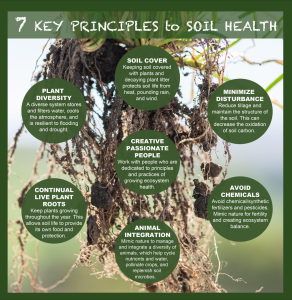
The 7 soil health principles used at Paicines Ranch.
Cover cropping is perhaps the clearest example of the single-practice approach today. The principle is that soil should be covered with living or dead organic material, and there are many ways to accomplish that, each with its own nuance. A farmer who chooses a cover crop over an alternative like mulching still faces a long list of decisions: when to plant, what to plant (especially how many species from how many plant families), when and how to terminate, and how to integrate it into the rest of the rotation. The right answers all depend on context. Just as important, soil cover is only one principle, and it works best when considered alongside the others. But it is also important to think of other principles and how to integrate them concurrently. A second principle is to keep green, growing roots in the ground as much of the year as possible. This might lead to the decision to plant a cover crop rather than use mulch. There is another principle to integrate animals when possible. This argues for a cover crop rather than mulch if animals are available. And, of course, at the same time the practitioner has to produce a cash crop, or maintain a park, or grow a garden.
If this sounds complex, that’s because it is, and we haven’t even touched on how the crop insurance system constrains what farmers can do or our bizarre national obsession with eradicating weeds, i.e. any plant that we didn’t plant. The reality is that in managing virtually all of our landscapes today, whether or not in agriculture, we violate these principles all of the time, day after day, spending lots of time, fossil fuel, and money to do it.
How do we as a society convert our land management to create healthy soil? We have to educate land managers on the principles of healthy soil, and then give them the flexibility to implement practices for their context with ongoing education, peer learning, economic support and risk mitigation, data, and encouragement.
We also need to realize that it’s about all of us and all of our landscapes – parks, yards, medians, gardens, and more. While we support the farmers making change in their fields “out there”, it is important to look at the landscapes around us “right here” in light of the principles of healthy soils. Where can we rethink our own paradigms and lobby for change? Where can we create more life and biodiversity in our own lives?