
Imagining What is Possible
 by Sallie Calhoun
I firmly believe, and frequently say, that we have no idea what’s possible in regenerating ecosystems. We are so far removed — in time and function — from healthy ecosystems that we can’t really imagine what they could look like in our various places. We have all read accounts of huge flocks of passenger pigeons, herds of bison, and thousands of square miles of prairie. Those images are in our rational minds, but they usually seem so far removed from our reality as to be irrelevant. Managing for regeneration today requires faith, imagination, and a true confidence in our ability to partner with nature for positive change. Too often, humans are seen as only able to harm natural systems. We are advised by experts on how not to do further harm, or how to be “sustainable.” Dreams of regeneration leading to abundance and diversity and life, especially in the context of food production, are often dismissed as utopian ideas.
But if we are watching, I believe that Mother Nature is sending messages showing us that this is not the case. We experienced this in the spring of 2023 on Paicines Ranch in a totally unexpected way. After 22 years of mostly dry years, we experienced a very wet season. In Paicines, that translates into 18 inches of rain, where 11 is the 100-year average, and we have recently experienced 3 and 5. And the most amazing thing happened!
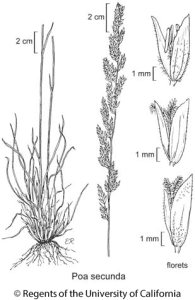
My favorite cool-season perennial grass on the ranch is poa secunda, or junegrass. It was the first perennial grass I found here, discovering a small patch in one paddock almost 20 years ago. At that time, across the ranch, there were very few poa secunda plants. They have really beautiful seed heads, and I walked around the ranch in spring every year searching for more examples. The plants are quite small. In a normal rain year, they are barely visible and put up on average 1 or 2 seed heads that are about 12 inches high. They mostly appear on north-facing slopes in small patches. In a dry year, they don’t appear at all, and I was afraid that they had died during the 5-year drought.
But that spring they were everywhere! On every aspect, in every paddock. There were literally millions of them. These were not seedlings. Many of them were the largest plants I have ever seen, with 5 or 6 seed heads towering 18 inches high. It is the most exciting thing I have seen in my time on this landscape, but you had to be paying attention to see it. It wasn’t flashy. It was just amazing.
How could it happen? We talk hopefully about the seed bank and how long seeds may be viable, but I haven’t heard much discussion of dormant plants, and their potential to dramatically change a landscape incredibly quickly. We haven’t seen these plants in the 22 years that we have been here, and have no idea when they last appeared.
Of course, this raises more questions than it answers. Will large numbers of poa secunda return with lower rainfall? Did management changes over the last 16 years matter? Is this also happening with purple needlegrass? What else is waiting for the right conditions to enable a return? What is possible in this place?
I work every day to imagine and develop the patience to watch for the messages indicating that we are on the right path. And this was a very good spring.