
Allowing Nature to Flourish in Agriculture
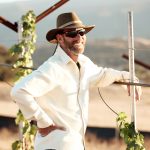 by Kelly Mulville, Paicines Ranch Vineyard Director (originally written for participants of the Capital Commons Summit).
Within two days of suggesting to the vineyard crew that they unplug their earbuds for at least a couple of hours a day in order to be more present, I got this message: “I’m hearing a strange bird.”
“Does it sound like a cat?” I replied.
“Yes!”
It was a Tri-colored Blackbird, an endangered species found almost exclusively in California. We usually see a few each spring or summer, but over the following weeks the numbers climbed steadily until we had what appeared to be a flock of around 200. That was an exciting enough phenomenon to warrant a call to our local bird expert, Debra. She quickly suggested that I didn’t know how to count birds—the flock was most likely a blend of various blackbird species and starlings—but she offered to come see for herself.
The next morning Debra drove up to the vineyard and located the flock. “Holy shit, Kelly,” echoed up from the bottom of the vineyard. I ran down to see what was happening. “Well, I was right—you don’t know how to count birds. This flock is closer to 700. And almost all of them are Tri-colored Blackbirds.”
During the mornings the “Trikes”—as they’re known to birders—would descend as a cloudlike mass into the tall grasses around the vineyard’s perimeter. Almost immediately upon landing, the birds in back would fly over the birds in front and settle again, creating the effect of a wheel of birds rolling across the landscape. Mesmerizing to watch, this cooperative behavior stirs up insects like a paddle wheel. In the afternoon the Trikes would break up and scatter through the vineyard rows, foraging for insects and gracing us with their distinctive feline calls.
The flock swelled to roughly 3,000 birds for about a week, then winnowed to around 1,000 that bred and nested at a spring-fed pond half a mile from the vineyard. Bird researchers from around the state converged on the ranch to witness the phenomenon and try to understand what had drawn such a large colony to this site.
Why Here?
Why the Tri-colored Blackbirds chose to congregate, nest, and breed at our ranch is mostly a mystery—or maybe not. It was a dry year across much of California, including San Benito County. Agriculture is the primary driver of the species’ decline. As native wetlands and grasslands are converted to cropland, colonies are increasingly forced to nest in hay fields, where eggs and nestlings are destroyed during harvest. Meanwhile, the widespread use of pesticides has dramatically reduced the insect populations these birds depend on for food.
Our vineyard offered something different. For more than a decade we have managed the property with supporting ecological health as a guiding principle alongside production. A high diversity of introduced and endemic plants grows between and under the vine rows year-round, building soil health and supporting insect life. As a certified organic farm, we use no synthetic pesticides or herbicides and don’t use organic-approved products that are harmful to beneficial insects. The spring-fed pond and its surrounding riparian corridor are left intact. None of this was designed with Tri-colored Blackbirds specifically in mind, but the cumulative effect was a landscape with the habitat structure, food resources, and safety these birds needed—precisely the things industrial agriculture has been stripping from landscapes throughout the world.
The Cost of Simplification
The fate of the Tri-colored Blackbird reflects a broader pattern of ecological disruption. Current agricultural practices are responsible for an estimated 80% of global deforestation and 70% of terrestrial biodiversity loss. As native habitats are cleared and simplified into monocultures, ecosystems that evolved over millennia are replaced by production systems requiring ever-increasing chemical inputs to remain viable.
The consequences extend far beyond wildlife. Intensive tillage releases stored carbon into the atmosphere while degrading soil structure and organic matter, leaving land more susceptible to erosion. The loss of natural vegetation disrupts water cycles, contributing to both floods and droughts. And the collapse of insect populations—sometimes called the “insect apocalypse”—cascades through food webs in ways that threaten not just birds, but the pollination and pest-control services agriculture itself depends on.
The Economics of Working with Nature
For an audience of early-stage practitioners, the natural question is whether a novel approach can pencil out. The conventional framing treats ecological health and farm profitability as trade-offs: you can protect nature, or you can make money. But a growing body of evidence—and a growing number of farm-level balance sheets—suggests this framing is wrong.
At Paicines, designing and managing the vineyard to allow nature to flourish has shown that a healthy ecosystem covers services most operations pay dearly for. We incur a fraction of the production costs that most other vineyards face for fertility, pest and disease control, tillage, mowing, weeding, and suckering—because a functioning ecosystem provides these services largely for free. At the same time, we’ve seen improved water infiltration and soil water-holding capacity, lowering irrigation demand in a region where water is expensive and increasingly scarce.
We’re not unique. Research from institutions including the Ecdysis Foundation and Iowa State University has found that regenerative farms often match or exceed the profitability of conventional neighbors, in part because lower input costs offset any modest yield differences. When the ecosystem services these farms provide—carbon sequestration, water filtration, pollinator habitat, flood mitigation—are accounted for, the economic case strengthens further. The challenge is that most of these benefits are externalities under current market structures: real and valuable, but not captured on the farm’s income statement.
Reimagining the Ledger
What if agriculture could be understood not as a source of environmental degradation, but as a force for ecosystem restoration? The presence of Tri-colored Blackbirds in our vineyard is a small but tangible demonstration that this is possible. Through careful design and management, farming systems can build soil health, increase biodiversity, improve water cycles, and enhance long-term productivity—outcomes that are good for the land and good for the bottom line.
Contemporary agriculture tends to optimize from a single perspective: production per acre. This narrow focus can deliver impressive short-term yields, but it leaves a trail of unintended consequences—degraded soils, impaired waterways, collapsed ecosystems, struggling rural communities—whose costs are borne by someone other than the producer. A fuller accounting would recognize that healthy ecosystem processes are not obstacles to profitable farming; they are its foundation.
For those of you building careers in business, this represents both an intellectual challenge and an enormous opportunity. How do we design markets, incentive structures, and accounting frameworks that make the true costs and benefits of agricultural practices visible? How do we move ecosystem services from the externality’s column into the price signal? The answers to those questions will shape whether the story of the Tri-colored Blackbird ends in further decline—or in a landscape where farming and flourishing are the same thing.
The Grace of Pantheism
I hold no allegiance to any religion, but this work — this long, quiet collaboration with the people and nature of this place — has been a most profound and humbling experience. Simply producing great wine was never the sole aspiration, though that is being realized. The deeper hope was to discover what becomes possible when we stop managing nature and begin allowing it to self-express. What I’ve found is something I didn’t expect: a kind of grace. The vines are healthier. The soil is alive. There are many more plants and insects than when we started. Three thousand endangered birds arrived one spring and decided this was a place worth staying. And yes, the economics work — not because we engineered them to, but because a thriving ecosystem, it turns out, is generous. That may be the most humbling lesson of all: that when we offer the land our trust, it returns far more than we had the imagination to ask for.